
Thank you for trusting Chico Eye Center with your eye care! From your very first visit to every step in your care, our goal is to make sure you feel comfortable, supported and confident that you’re receiving the best care for your eyes.
Prior to your visit, we will text and email you a link to complete our pre-registration forms, confirm your insurance, and update your medical history. You may also download the standard forms below. We request that you arrive 10 minutes before your scheduled appointment to complete the electronic registration. Completing the pre-registration electronically will allow a more efficient use of your time in the office.
For comprehensive eye exams, please allow 1.5 to 2 hours for your visit. Since your eyes will most likely be dilated, please remember to bring your sunglasses. You may also wish to bring a friend or relative to drive you home.
If the appointment is for a minor (under 18 years of age), please note that, for legal reasons, a parent or guardian must be present during the exam. Families should plan for the pediatric eye exam to last approximately 2 hours, allowing adequate time for dilation.

Why do we include pupil dilation in pediatric appointments? Dilating a child’s pupils allows for clear examination of the inside of the eye and obtaining the most accurate eyeglass prescription. Pupil dilation is typically recommended at the first visit and annually thereafter. There will be a 30-minute break during the appointment to allow the pupils to dilate. After dilation, vision may be blurry for up to 24 hours.
Downloadable Patient Forms:

Chico Eye Center ensures each visit to our office is customized to you, including your appointment. Our highly trained and certified staff listen to your needs at every step. Scheduling gathers information to schedule the proper appointment type. The technicians take a deeper dive into what brings you into the office and performs the necessary vital signs and testing to gather the appropriate information for your doctor.
Often referred to as Annual Eye Exams, these appointments are important to have every year as many medical conditions develop before visual symptoms are noticed. Regular eye exams allow doctors to detect these conditions, like glaucoma and macular degeneration early, and often before significant damage has occurred.
These appointments can be a routine health check provided by your vision insurance or evaluate medical conditions through your medical insurance.
These exams are problem-focused and are often shorter visits. Dilation and refractions are less common, but possible as your complaints and symptoms dictate the exam. These exams are always billed to your medical insurance.
We’re equipped to treat non-life-threatening eye emergencies that still require immediate care. If you have a life-threatening emergency, call 911 right away or go to the nearest emergency room. Our team will triage your symptoms and schedule an appointment based on your needs – whether it’s same day, within 1-3 days, or at your convenience.
If a same-day visit is needed, we’ll give you an arrival time to help minimize waiting. These appointments are seen by the first available doctor, and while we can’t guarantee a specific provider, our entire team is highly trained to handle urgent eye issues.
If you experience an eye injury or sudden changes in vision, call us right away at 530-767-3768. For after-hours emergencies, call 911 or visit the nearest emergency room or urgent care – their team can contact us if needed.
Some signs and symptoms of an eye emergency that should be checked right away include:
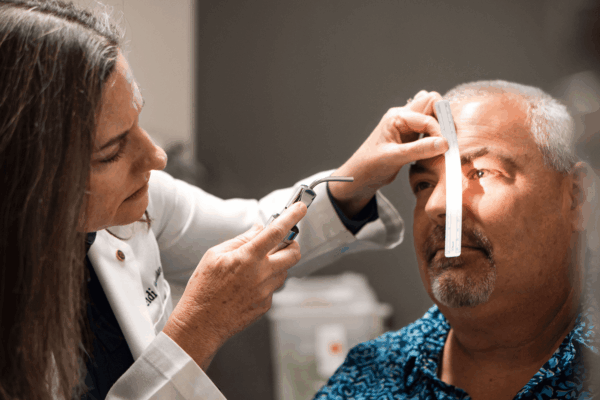
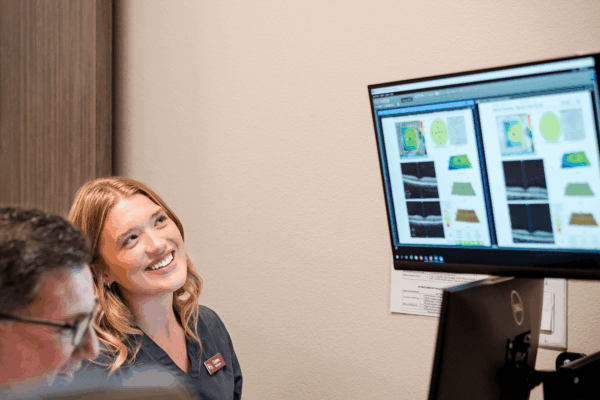
All exams share similar components and are used to provide the best evaluation of your eye health. Every exam must have vision, eye pressure, and pupil evaluation as these are considered Chico Eye Center’s vital signs for eye health.
Testing your vision will be done for distance and near. Your vision will be checked with and/or without glasses or contact lenses. Your vision is described as a fraction. The top number represents your distance in feet from the chart, while the bottom shows the distance a person with standard vision can read that line. 20/20 vision is the term for normal visual acuity.
This test is a diagnostic tool used to determine the health of your eyes and how well you see. It can be part of a comprehensive exam or used for any appointment with a complaint in changes in vision. As a side benefit, it can also result in a prescription for eyeglasses. Some people only need correction for reading, while others need correction for distance and near.
The pupil is the black circle in your eye that changes size to regulate how much light enters your eyes. The way your pupils react gives us an idea of how your optic nerves (and sometimes your brain) are working. Differences in pupil sizes, slow responses to changes in lighting, or different reactions between eyes may indicate eye problems.
There are 6 primary muscles responsible for controlling the movements of each eye. Usually, these muscles work in tandem to ensure proper alignment and vision. Tracking the movement and rotation of eyes determines if the eyes are staying lined up as they move in different directions.
This test is performed one eye at a time and is used to detect large peripheral vision losses.
Also called IOP for Intra Ocular Pressure, this pressure, or force inside eyes is created by fluid produced within the eye and the amount of fluid draining out of the eye. If the pressure is abnormally high or low, this can be an indication of eye problems.
Depending on your personal or family history or the findings during the exam, additional specialized testing may be required to further evaluate the function or status of specific eye structures
This part of the exam evaluates the surface of your eye, cornea and the anterior chamber. The Anterior Chamber (AC) examination evaluates the space between the cornea and iris to assess depth, inflammation, and drainage. This area is responsible for the forefront of how your eyesight works.
Light-sensing tissue and nerve cable at the back of the eye are checked for diseases like glaucoma, diabetes, and macular degeneration. Usually performed via pupil dilation, your doctor uses specialized lights and lenses to view the structures and vessels in high detail.